Complete Guide to Unwind Web Guide Systems: Working, Benefits and Applications
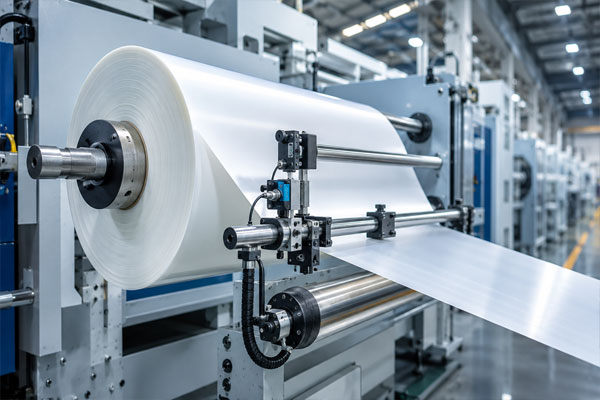
Roll-to-roll machines continuously process materials such as plastic film, paper, foil, labels, fabric and non-woven material. During unwinding, the material roll may move slightly from left to right because of incorrect roll loading, uneven edges, shaft movement or machine vibration. This lateral movement can affect printing, coating, laminating, slitting and cutting accuracy.
An Unwind Web Guide detects the position of the moving material and automatically corrects the unwind roll position. It keeps the web aligned before the material enters the main production process.
Venkinto Industries Pvt. Ltd. provides web-guiding, sensing, motion-control and tension-control solutions for printing, packaging, converting and web-processing industries from Ahmedabad, Gujarat. Its product range includes smart controllers, ultrasonic sensors, infrared sensors, CCD image sensors and BLDC motor actuators.
What Is an Unwind Web Guide?
An Unwind Web Guide is an automatic alignment system installed at the unwinding section of a roll-to-roll machine. It controls the side-to-side position of the material while it is being released from the parent roll.
The system continuously monitors the material edge, centre line, printed line or printed pattern. When the web moves away from its required position, the controller sends a correction command to the actuator. The actuator shifts the complete unwind stand or roll in the required direction.
Venkinto Industries describes web edge guiding as a solution used to control the lateral shifting of material width in printing, packaging, film, paper, laminating and converting processes.
Why Is Web Alignment Important During Unwinding?
A material roll may appear correctly aligned when the machine starts. However, its position may change continuously during operation.
Common causes of web movement include:
- Incorrect roll loading
- Unevenly wound parent rolls
- Telescopic rolls
- Bent or damaged cores
- Shaft misalignment
- Machine vibration
- Variation in material thickness
- Uneven web tension
- Roller alignment problems
- Changes in production speed
How Does an Unwind Web Guide Work?
Web Position Detection
A sensor is installed near the web path. It continuously checks the actual position of the material edge, centre or printed reference.
Depending on the material and application, the machine may use:
- Ultrasonic edge sensor
- Infrared edge sensor
- Optical sensor
- CCD image sensor
- Line or contrast sensor
- Camera-based sensor
Web Position Correction
The roll moves until the material returns to the required position. The process continues automatically while the machine is running.
In a typical unwind guiding arrangement, the sensor is fixed to the machine and the winding station is moved through a linear drive. The sensing point should normally be placed close to the final guide roller of the unwind station for responsive position correction.
Signal Transmission
The sensor sends the actual web-position signal to the web guide controller.
Error Calculation
The controller compares the detected position with the required set position. It calculates the direction and amount of correction needed.
Actuator Movement
The controller sends an output command to the actuator. The actuator shifts the unwind stand or roll sideways.
Benefits of an Unwind Web Guide
Accurate Material Alignment
The system maintains a consistent web position before printing, coating, laminating, slitting or other processing.
Reduced Material Waste
Automatic correction helps prevent incorrect cuts, damaged edges, wrinkles and rejected production.
Improved Print Registration
Stable material positioning supports better colour-to-colour and print-to-cut registration.
Better Slitting Accuracy
The web enters the slitting section at the required position, helping maintain consistent finished roll widths.
Improved Lamination Quality
Correct alignment between different material layers reduces overhanging edges and uneven lamination.
Higher Machine Speed
Operators can run machines at higher speeds without continuously making manual side-position adjustments.
Reduced Operator Work
The system automatically corrects web movement, reducing dependence on manual monitoring.
Consistent Production Quality
Continuous correction supports repeatable results throughout long production runs.
Suitable for Machine Retrofitting
An Unwind Web Guide can often be added to an existing machine to improve alignment and production performance. Venkinto Industries provides solutions for machine retrofitting, modification and automation in web-processing applications.
Industrial Applications of Unwind Web Guides
Rotogravure Printing Machines
The system keeps plastic film, paper or foil aligned before it enters the printing unit.
Flexographic Printing Machines
Accurate web positioning supports print registration and consistent label or packaging production.
Lamination Machines
The unwind guide aligns different layers before they are bonded together.
Coating Machines
It maintains the material position before adhesive, chemical, silicone or protective coating is applied.
Slitter Rewinder Machines
The system aligns the parent roll before slitting, helping produce rolls with consistent widths.
Label Printing Machines
Narrow web guiding supports accurate printing, die cutting, inspection and rewinding of labels.
Film Extrusion Machines
A web guide can help align film before winding, printing or secondary converting operations.
Paper Processing Machines
It is suitable for paper coating, printing, cutting, sheeting and rewinding processes.
Woven Sack Machines
The system can guide woven fabric during printing, coating, cutting and bag-making operations.
Conclusion
An Unwind Web Guide is an important solution for maintaining accurate material alignment in roll-to-roll machines. It detects unwanted side movement and automatically shifts the unwind stand to keep the web in its required position.
The system helps improve printing, coating, laminating, slitting and rewinding quality. It can reduce material waste, operator involvement, alignment errors and production rejection.
For reliable results, the sensor, controller, actuator, correction range and unwind structure must be selected according to material type, web width, roll weight and machine speed.
Venkinto Industries Pvt. Ltd. offers web-guiding, sensing, actuator and tension-control solutions for different printing, packaging and converting applications.
Frequently Asked Questions
An Unwind Web Guide is an automatic system that controls the side-to-side position of material as it is released from a roll.
A sensor detects the material position, a controller calculates the error and an actuator shifts the unwind stand to correct the web position.
It can guide paper, plastic film, foil, labels, fabric, rubber, woven material and non-woven webs.
Web guiding controls lateral material position, while tension control manages the pulling force applied to the moving web.
An ultrasonic sensor or another sensor specifically designed for transparent material is generally suitable, depending on the application.
Yes. A line sensor, contrast sensor, CCD image sensor or camera-based sensor can guide the web using a printed reference.
Yes. Many existing printing, laminating and slitting machines can be upgraded with a web guide after checking their structure and available space.
Possible causes include excessive controller sensitivity, incorrect sensor position, unstable tension, actuator settings or mechanical misalignment.
They are used in printing, flexible packaging, labels, paper, textile, non-woven, foil, film extrusion and converting industries.
Venkinto Industries Pvt. Ltd. in GIDC Vatva, Ahmedabad, provides web-guiding, motion-control and tension-control solutions for industrial machines.